All signs show Canada can’t meet its Paris target — here’s why Ottawa won’t admit it
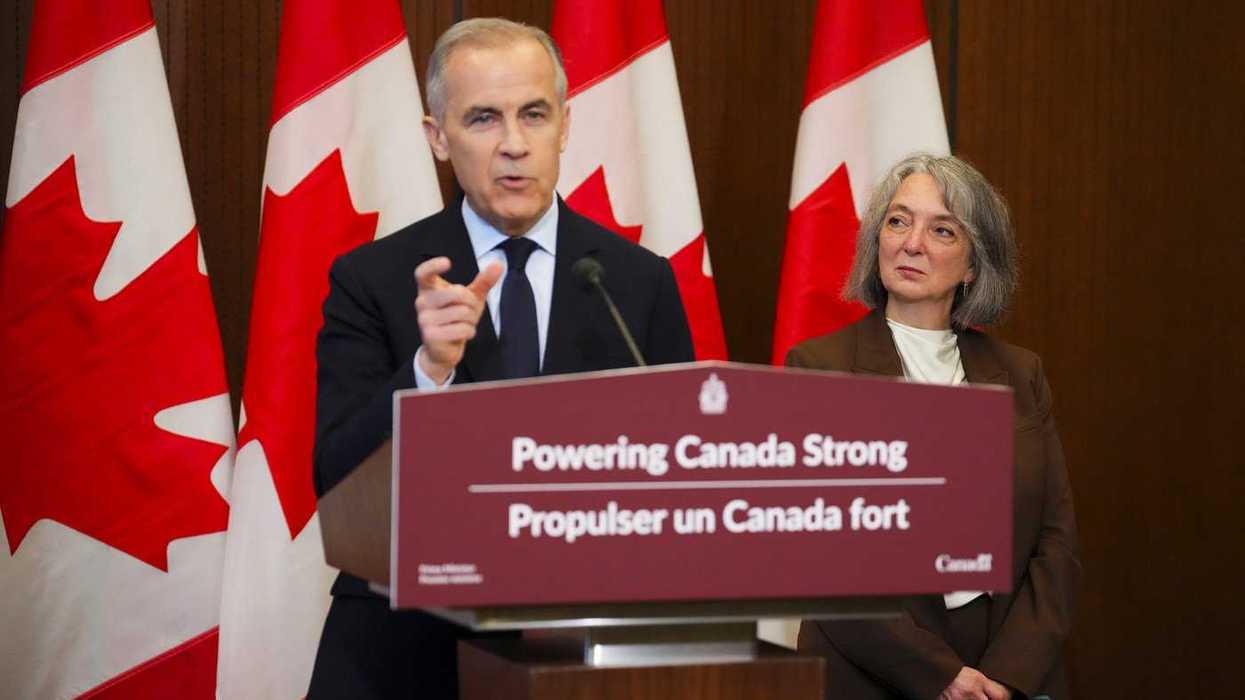
In June, Prime Minister Mark Carney told Canadians that the country's emissions would be higher “in the next few years” than previously projected. Those projections already said Canada would miss its 2030 emissions target under the Paris climate accord.
The government's own projections — published in its emissions reductions progress report a year ago — showed a best-case scenario of a 28 per cent reduction in emissions from 2005 levels in 2030.
And that was before the Carney government introduced a suite of climate policy rollbacks over the past year, including a delay to the introduction of more stringent tailpipe emissions. That measure was supposed to take the place of the now-scrapped electric vehicle sales mandate; it won't come into effect now until at least 2029.
Canada's commitment under the Paris agreement was to cut emissions by between 40 to 45 per cent of 2005 levels. The government of Stephen Harper set a target of 30 per cent.
This week, Environment Minister Julie Dabrusin insisted Canada is committed to its Paris commitments. That claim earned her some public criticism from two of her predecessors while she attended the United Nations climate conference in Turkey last week.
Dabrusin wouldn't answer when asked whether that commitment includes the 2030 target. In its public statements, the government has leaned on the target of achieving net-zero by 2050.
All the studies suggest Canada won't meet its target. The government's own projections say it will miss it. The prime minister himself acknowledged emissions are on the rise. So why hasn't the federal government said it is no longer committed to the 2030 target?
"I think they're afraid to come out and say it because it's putting in people's faces that they're making a choice to make wildfires worse, to make flooding worse, to actually leave a worse world for our children," said Keith Stewart, senior energy strategist with Greenpeace Canada.
"Julie Dabrusin seems like a very nice person. But she's going to go down in history as the worst environment minister in Canada's history because it's been on her watch that Canada has rolled back environment and climate policies in a way that not even Stephen Harper attempted."
Asked whether Dabrusin has been put in the job to defend Carney's policy choices, Stewart said nobody is under the impression that she is "calling the shots."
"This is clearly coming from the prime minister. But she's at that cabinet table and she's standing behind those decisions. And as someone who has said she's committed to action on climate change, her other option is to resign in protest to make it clear that this is unacceptable," Stewart said.
"If being at a cabinet table is more important to you than having the right decisions come out of the cabinet table, that's a choice a politician can make."
In a statement, Dabrusin's office said Canada is "committed to its Paris agreement of achieving net-zero by 2050." The statement did not address a direct question of whether Canada is still committed to its 2030 target.
"We cannot achieve our climate goals when we are divided," wrote Amy Falkner, Dabrusin's press secretary.
"Our focus is on results that unite Canadians: building major clean energy projects across the country, driving mass electrification, making significant investments in the low-carbon economy, and working in co-operation with provinces, territories and Indigenous Peoples."
Falkner added that Canada is still committed to reporting its progress under the Net-Zero Accountability Act as required in December 2027, and will report on its 2030 target next month to the United Nations Climate Change Secretariat — as required under the Paris Agreement.
But whether the Net-Zero Accountability Act even has any teeth was the subject of debate on Parliament Hill this week. The act doesn't set out any fines or penalties for Canada missing or abandoning its climate targets.
At Thursday's meeting of the House of Commons environment committee, B.C. Conservative MP Ellis Ross grilled Canada's interim environment commissioner on what purpose the act even serves.
"It seems like everybody agrees, except government, that they're not going to meet their targets. So when the government is clearly falling short of emissions targets, and in actuality intends to expand its emissions, what exactly does the Net-Zero Accountability Act do?" Ellis asked.
"We've been talking about (emissions) for the better part of 20 years. But in terms of the 2030 commitments and 2050 commitments, we're not going to meet it. So does the Net-Zero Accountability Act mean anything today?"
Elsa Da Costa, the interim environment commissioner, replied that the act was an "important tool" for her office to hold the government to account.
The Angus Reid Institute released an online poll of 1,770 Canadians in July which suggested climate was the top issue for 21 per cent of respondents.
The poll also suggested the Liberals' track record on climate might be driving one in six Liberal voters to the NDP. The poll found climate was the top concern for half of NDP supporters.
The Canadian Research Insights Council, an industry organization that promotes polling standards, says online surveys cannot be assigned a margin of error because they do not randomly sample the population
Aside from the political repercussions of publicly abandoning its commitment to the 2030 emission targets, Stewart said there are also legal implications.
The federal government is fighting a lawsuit brought by a group of climate advocates over Canada's trajectory on emission commitments. The lawsuit is asking the Federal Court to order Ottawa to bring its 2030 emissions reductions plan into compliance with the Net-Zero Accountability Act.
"The courts can order the government to do something," said Julia Levin, the associate director of national climate with Environmental Defence, one of the organizations behind the lawsuit.
"There is a clear consequence to that. But it is mostly political."
Levin said climate change has become a point of political vulnerability for the Liberals.
"The prime minister knows this, and that's why he's done everything to dismantle the 2030 target. But I think it's the reason that they won't actually admit that they've abandoned this target," Levin said.
"Internationally, this is a prime minister who cares deeply about his international reputation. And it's hard to claim middle-power status and moral authority when you've abandoned a target that your peers are way more committed to."
An analysis last year by the think tank 440 Megatonnes found Canada was the worst performer among G7 countries at reducing emissions compared to 2005 levels. All other G7 countries had an average reduction of 32 per cent by 2023, while Canada had only achieved 8.5 per cent.
This report by The Canadian Press was first published Nov. 21, 2026.
By Nick Murray | Copyright 2026, The Canadian Press. All rights reserved.